What People Say, Do, and Buy: How Media Planners Build Personas on Proof, Not Guesses
Every audience decision rests on three kinds of proof: what people say they want, what they actually do, and what they actually buy. Media planners often have access to only one or two of these at a time, and rarely with the same depth across the board.
In practice, that means planners often work with behavioral proxies, contextual signals, or purchase data, and even when one signal is solid evidence, the full picture is still built on partial information. That gap becomes apparent the moment a campaign goes live, as the audience a planner intended to reach differs from the audience actually being served.
Ogury addresses that gap within Ogury One, its agentic-supported platform. It combines what people say, what they do, and what they buy into a single persona, with newly added data layers that make the “do” and “buy” pillars more comprehensive than before.
The process starts simply: when a media planner submits a brief, Ogury One’s agent reads it to extract the brand, market, objective, and audience, and identifies the brand’s direct competitors for category context. From there, the three pillars take over.
The Three Pillars: Say, Do, Buy
What People Say: Ogury’s proprietary survey panel qualifies the open web and is the foundation for every persona built, providing the declarative layer: what people actually say about themselves.
What People Do: Ogury’s own proprietary crawler analyzes semantic and contextual signals at the URL level rather than just the domain level, covering over a million URLs and five million app descriptions. Additional data partnerships extend that contextual coverage across Ogury’s entire in-app and web inventory, providing the socio-demographic foundation behind every persona.
A new layer of search and browsing behavioral data, based on eight million panelists globally, adds further depth. The brand itself becomes the starting point: by anchoring on who already engages with it, or with its category, this layer reveals what that same audience searches and browses elsewhere, turning raw traffic into a persona built on real intent.
What People Buy: Mastercard and NIQ make up the deterministic layer of the model: insights based on real transaction data, not estimates. Mastercard covers online and offline spending and has long been part of Ogury’s model. NIQ is the new addition, bringing retail purchase data with product-level detail for CPG-specific campaigns.
No Black Box: None of this works if planners can’t see where it comes from. Every signal that builds a persona in Ogury One is traceable: a media planner can see exactly which declared response, which search behavior, and which purchase signal contributed to a given audience. Nothing is generated behind the scenes: if a signal isn’t in the source data, it simply isn’t in the output.
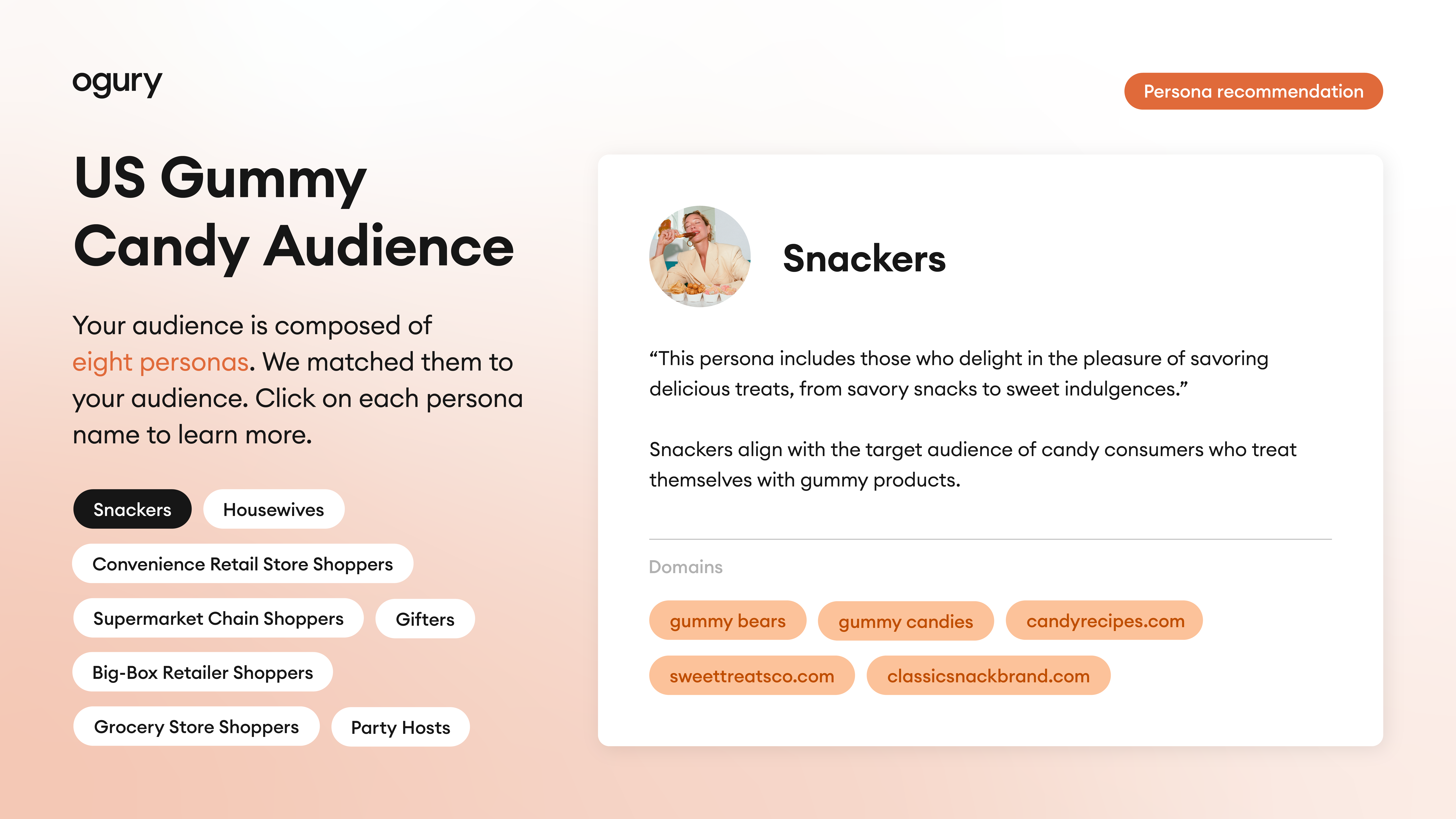
Introducing Search Behavior and Retail Purchase Data
Two additions are driving this shift, and they’re worth examining on their own.
Before the new search and browsing layer, Ogury’s observed-behavior data could tell a planner where an audience spent time online, but not what that same audience was actively searching for elsewhere. A single visit to a brand’s site says little on its own. But when that same visitor is also searching “organic ingredient list” and comparing products across retailer sites, the brand has a real seed to build an audience from, not just traffic to count.
This data also reveals less obvious audience signals. A planner exploring it might find unexpected overlaps, like a grocery-focused audience that’s also researching fitness recovery products, that a standard demographic model would never reveal. Nothing here needs digging up in the platform: the data is granular and transparent enough to put these overlaps in plain view from the start.
On the purchase side, Ogury already had Mastercard’s online and offline transaction data, but not tied to specific retail purchases. NIQ fills that in for CPG and retail brands, with exact product names and real purchase behavior behind every signal. For a CPG brand, that provides valuable competitive insights: identifying exactly which ZIP codes underperform against the category average reveals where the brand is losing ground to competitors, and where a shift in spend or messaging could make a difference.
When Online Behavior and Real Spending Tell Different Stories
Picture a quality-conscious grocery shopper segment: budget-aware, but unwilling to compromise on the quality of fresh produce, meat, or seafood. Roughly three-quarters of this audience say they’re reluctant to compromise on freshness, and a similar share believe quality is worth paying more for. The segment skews female and over 35.
Research behavior shows this audience searching for glass food containers, homemade bread, and sourdough starters, suggesting a clear “make it from scratch” mindset. They also search for things like ankle weights and heat packs, suggesting a broader interest in wellness that goes beyond food alone.
Based on online behavior alone, this audience appears highly concentrated in a handful of major metro areas, skewing urban and coastal. But Mastercard spending data tells a different story. Regions that looked quiet in the digital data, including smaller markets, less obviously urban or coastal, actually show significant spending. The audience exists and spends in places the online behavior data alone would have missed entirely.
That gap matters. A planner relying only on digital behavioral data could misallocate budget toward the most digitally active markets and underinvest in the ones where consumers are spending. Combining research behavior with transaction data helps address this imbalance, and the same principle applies beyond grocery.
There’s a second signal worth noting here too: this audience is significantly concentrated around two leading retailers in the category, with very little overlap toward smaller or value-positioned competitors. The real opportunity isn’t necessarily chasing net-new shoppers but understanding the share of movement between the handful of retailers this audience already considers.
CPG Deep Dive: Mapping the Competitive Battleground
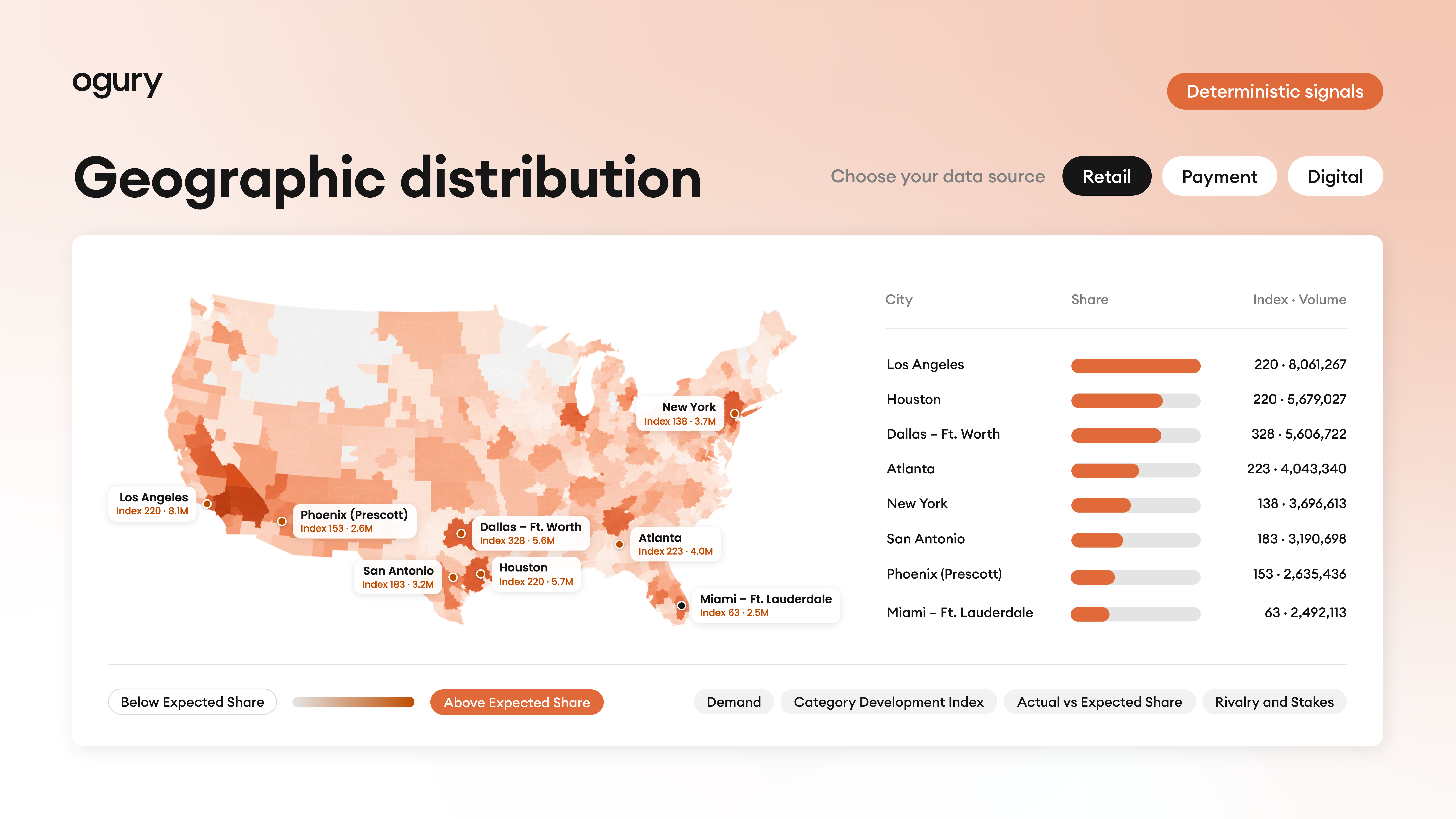
For CPG and retail brands, NIQ answers that same competitive question: who’s winning share and who’s losing it, down to the exact product.
NIQ allows a CPG brand to assess, ZIP code by ZIP code, exactly how it performs against the category average, based on real purchase data rather than estimates. That visibility leads to two very different strategies depending on where a brand stands.
Where a brand is already over-indexing and leading in market share, messaging can focus on premium offerings and quality, reinforcing the reasons it’s already winning there. A pet food brand that’s strong in a given region, for example, might emphasize premium nutrition or breed-specific wellness rather than competing on price.
Where a brand is under-indexing and trailing in market share, the dynamic changes. This is a more competitive territory, and the right response usually involves trial incentives, couponing, and a greater investment in media, since the goal here is conversion rather than reinforcement.
Mapped on a heatmap by ZIP code, over-indexed regions can represent an opportunity to expand volume, while under-indexed regions may require a different media and messaging approach. Pairing digital behavior geography with Mastercard and NIQ purchase geography provides a more comprehensive regional view than either source alone, informing not just whether to target a region but also which message to use. The result is a single, unified view that shows upper-funnel personas and research signals alongside lower-funnel competitive positioning by region, with creative recommendations tailored to each.
Built for Activation, Not Just Insight
None of the above matters if it can’t actually be put into a live campaign. Every persona carries declared and observed signals, plus purchase signals: Mastercard is always included, and NIQ is layered on top when the campaign is CPG. Once a persona is defined, it feeds directly into media planning, including inventory forecasts, recommended media mix, and suggested creative direction grounded in how the audience actually behaves.
A persona can be activated directly through Ogury’s own DSP, with all signals included automatically, or through third-party DSPs, where individual signals are extracted for use.
Declarative, behavioral, and deterministic signals, working together, help build more precise personas. Carrying those same signals into activation closes the loop: helping maintain consistency between the audience defined during planning and the audience reached across devices.
Say, do, buy: three kinds of proof, one persona, built and activated on the same ground.
Subscribe to
The Ogury Outlook
Get expert insights, industry news, events and actionable tips - directly in your inbox.